Unstable Realms
Unstable Realms
Devices
Works fine on tablets and PC (tested on both Android and Ipad).
Works but UI not optimized for mobile phones (tried on iPhone - UI need to be adopted for better UX)
Goal
Finish the 42-turn game with more money than either rival.
You play as the red Lord against two computer-controlled rivals:
- the blue Viscont, who bids cautiously;
- the green Baron, who considers the remaining turns, available money, and
resource cards still in the deck.
Every player begins with $100. Controlled hexes can earn income, but they do
not score points directly. Only money determines the winner.
The Realm
Each new game creates a random 5 × 5 realm. Every hex has one of seven
resources:
- Wood
- Sheep
- Grain
- Oil
- Ore
- Gold
- Fish
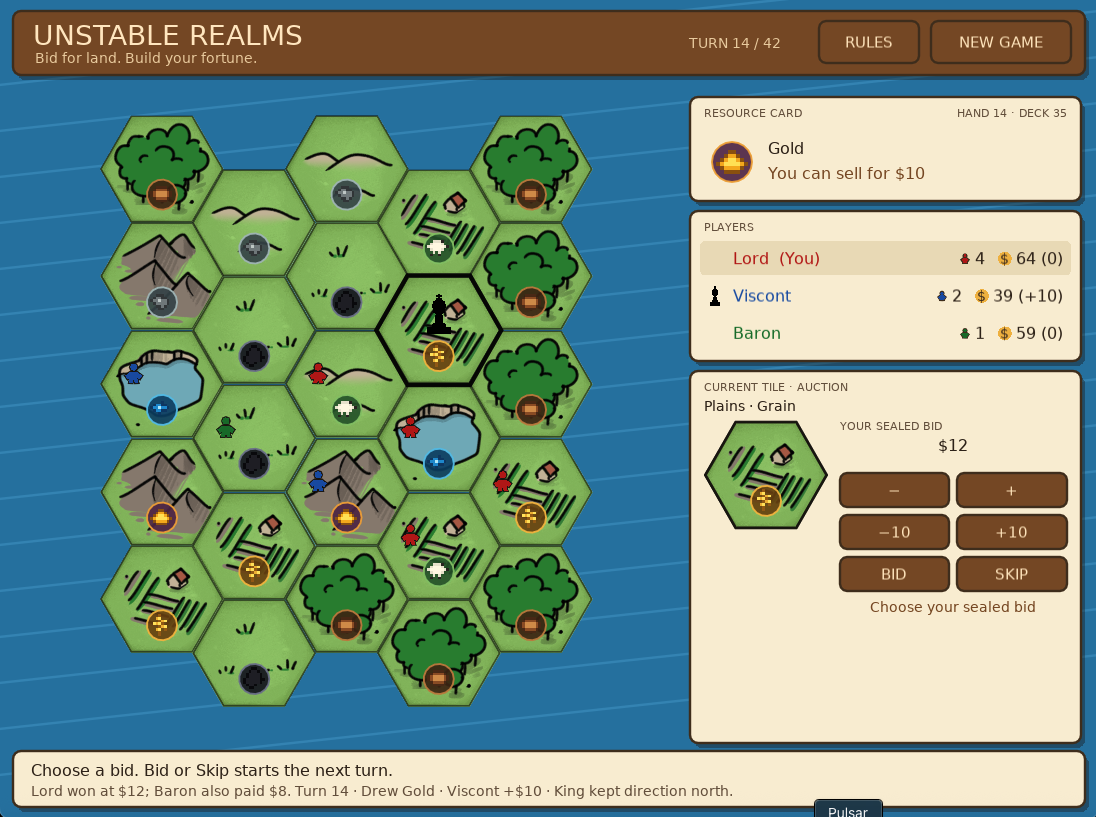
The King begins in the center and travels around the realm. His current hex is
the one offered in that turn's auction.
How a Turn Works
Each turn has one sealed-bid auction:
1. Inspect the hex currently occupied by the King.
2. Choose your whole-dollar bid with the −, +, −10, and +10
buttons.
3. Select Bid to submit that amount, or Skip to submit a bid of $0.
4. The Lord, Viscont, and Baron reveal their bids simultaneously.
5. The highest bidder pays their bid and takes control of the hex.
6. The second-highest bidder also pays their bid but receives nothing.
7. Unless this was auction 42, the King moves, a resource card is drawn,
resource income is paid, and the next auction begins immediately.
There is no auction timer and no separate end-turn button. Selecting Bid or
Skip completes your turn. Your selected bid is remembered for the next
turn, but it is automatically reduced if you no longer have enough money.
Dollar-Auction Payments
This is a dollar auction: the two highest bid positions pay.
For example, if the bids are Lord $8, Viscont $5, and Baron $3:
- Lord pays $8 and controls the hex;
- Viscont pays $5 and receives nothing;
- Baron pays nothing.
You cannot bid more money than you currently hold.
Ties
If multiple players share the highest bid, the winner is chosen randomly from
those players. After the winner is selected, the highest remaining bidder is
the second payer. This means that in a two-player tie for first, both tied
players pay, but only the randomly selected winner receives the hex.
A $0 bid can still win when everyone bids $0; the tied winner is random and no
money is charged.
Controlling Hexes
The auction winner places a meeple of their color on the King's current hex.
If the hex already belongs to another player, the new meeple replaces the old
one. The former owner immediately loses control of that hex.
The player panel shows, for each player:
- their current money followed by the latest resource income in brackets, such
as `$120 (+20)` or `$120 (0)` when no income was received;
- a meeple in their color followed by the number of hexes they control.
Hex count is useful for understanding future income, but it is not part of the
final score.
Resource Income
The resource deck contains 49 cards: seven cards for each of the seven
resources. Every card is worth **$10**. If the deck is ever exhausted, all 49
cards are rebuilt and shuffled.
After the King moves into the next turn, one card is drawn. Every controlled
hex matching that card pays its owner $10. Each matching hex pays separately.
For example, when a Wood card is drawn:
- one controlled Wood hex earns $10;
- three controlled Wood hexes earn $30;
- controlled hexes with other resources earn nothing.
The opening card is drawn before anyone owns a hex, so it produces no income.
After the final auction, the game ends immediately—there is no additional
movement, card draw, or income payment.
King Movement
Between auctions, the King moves one neighboring hex. He usually chooses one
of the six directions at random, but may continue in his previous direction.
If that movement would leave the map, he reverses direction and moves back
into the realm.
The small black King marker in the player panel rotates between players as the
turn-order indicator. Auctions are still resolved from simultaneous sealed
bids.
Winning the Game
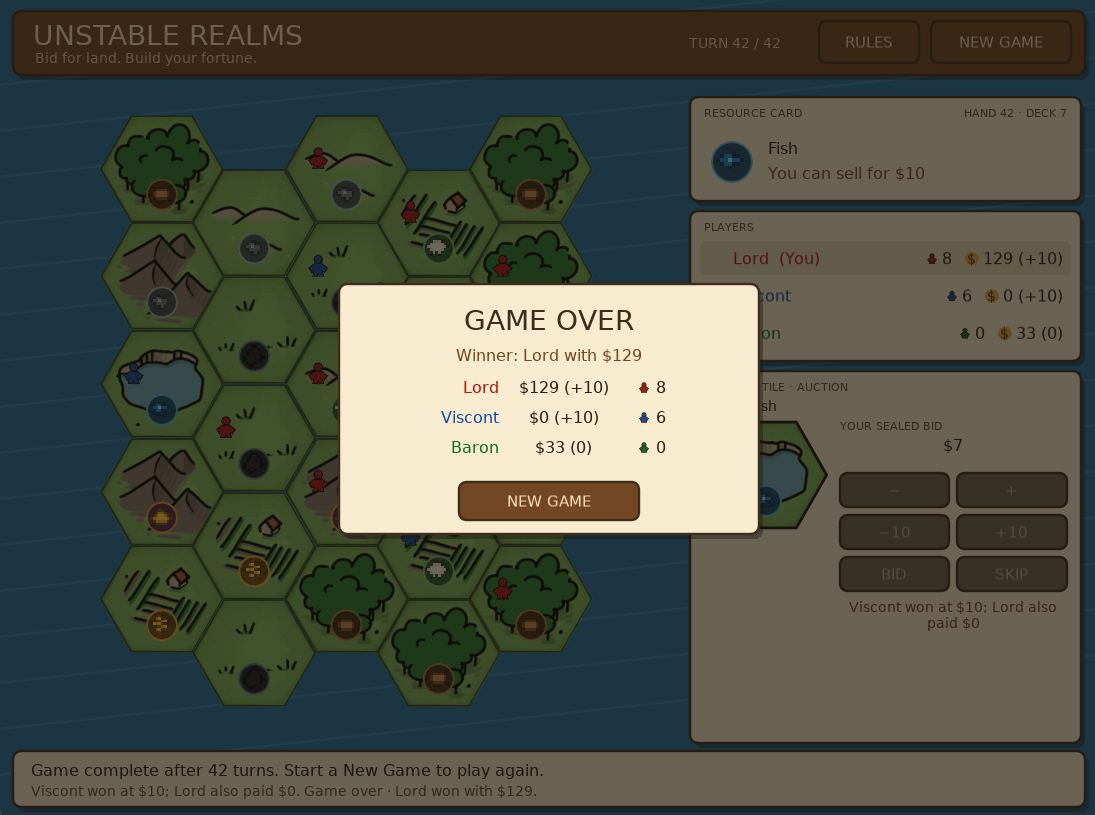
The game ends immediately after the 42nd auction. The player with the most
money wins, regardless of how many hexes they control. Players who finish with
the same highest balance share the victory.
The game-over window lists every player's final balance and controlled-hex
count. Select **New Game** to generate a new map and shuffled deck.
Controls and Screen Guide
- **− / +**: decrease or increase the selected bid by $1.
- **−10 / +10**: decrease or increase the selected bid by $10.
- **Bid**: submit the displayed bid and resolve the turn.
- **Skip**: submit $0 and resolve the turn.
- **Rules**: open a quick in-game rules summary.
- **New Game**: abandon the current game and start over.
- **R** or **Space**: start a new game.
- **Escape**: close the rules window, or quit when it is closed.
- **Hover a hex**: inspect its terrain and resource.
The resource panel shows the latest card, the number of drawn cards in the
hand, and the number of cards remaining in the deck. The footer summarizes the
latest auction, income, and King movement.
Basic Strategy
Treat a bid as a possible cost even when you expect to lose: second place pays
too. A hex becomes more attractive when its resource still has several cards
left in the deck and when the King is unlikely to revisit it soon. Late in the
game, a new hex has fewer opportunities to produce income, so preserving cash
usually matters more.
Watch all three balances. A rival with little money cannot make a large bid,
while a wealthy rival can pressure both first and second place. Skipping is
often better than paying too much for a hex that may return less income than
the bid.
Third-Party Assets
Hex Tiles: Fantasy
The PNG files in `assets/tiles/` are selected and renamed copies from the
Hex Tiles: Fantasy asset pack by cmartins (cmartins.art).
- Source: https://cmartins.itch.io/hex-tiles-fantasy
- License: Creative Commons Attribution-ShareAlike 4.0 International
- License text: https://creativecommons.org/licenses/by-sa/4.0/
The tiles are scaled at runtime and composed into randomized game maps. The
source artwork is otherwise unmodified.